Our air: cleaner, but not clean enough
/40 years of clean air policy in Switzerland
Since 1986, the Swiss Ordinance on Air Pollution Control has protected the air we breathe. At the time, forest dieback and acid rain dominated the debate. Today the air is much cleaner, thanks to low-sulphur fuels, catalytic converters, particle filters and strict emission limits. Particulate matter, ozone, nitrogen oxides and ammonia still harm people and nature, though. In Switzerland alone, particulate matter causes around 2'000 premature deaths a year (review by the Swiss Federal Office for the Environment, in German).
An underestimated threat:
ultrafine particles
Ultrafine particles cause nearly two million premature deaths worldwide each year, mostly in cities. That is the finding of a study by the Max Planck Institute for Chemistry and the University Medical Center Mainz. These particles are smaller than 100 nanometres and come mainly from combustion. The researchers are calling for limit values and routine monitoring (watch SWR, in German).
The heating season challenge
In 2024, wood burning caused almost 30% of PM2.5 emissions in Switzerland. During temperature inversions, pollutants build up close to the ground (tips from the Swiss Federal Office for the Environment FOEN, in German).
Good decisions need good data
The National Air Pollution Monitoring Network (NABEL) measures at 16 sites in Switzerland. Dense sensor networks can fill the gaps in between. In the ICOS Cities project in Zurich, for example, CO₂ was measured at around 60 locations to track greenhouse gas emissions partly with Decentlab’s DL-LP8P CO₂ sensors and DL-ATM22 wind sensors. Similar denser air pollution network could be imagined for the future.
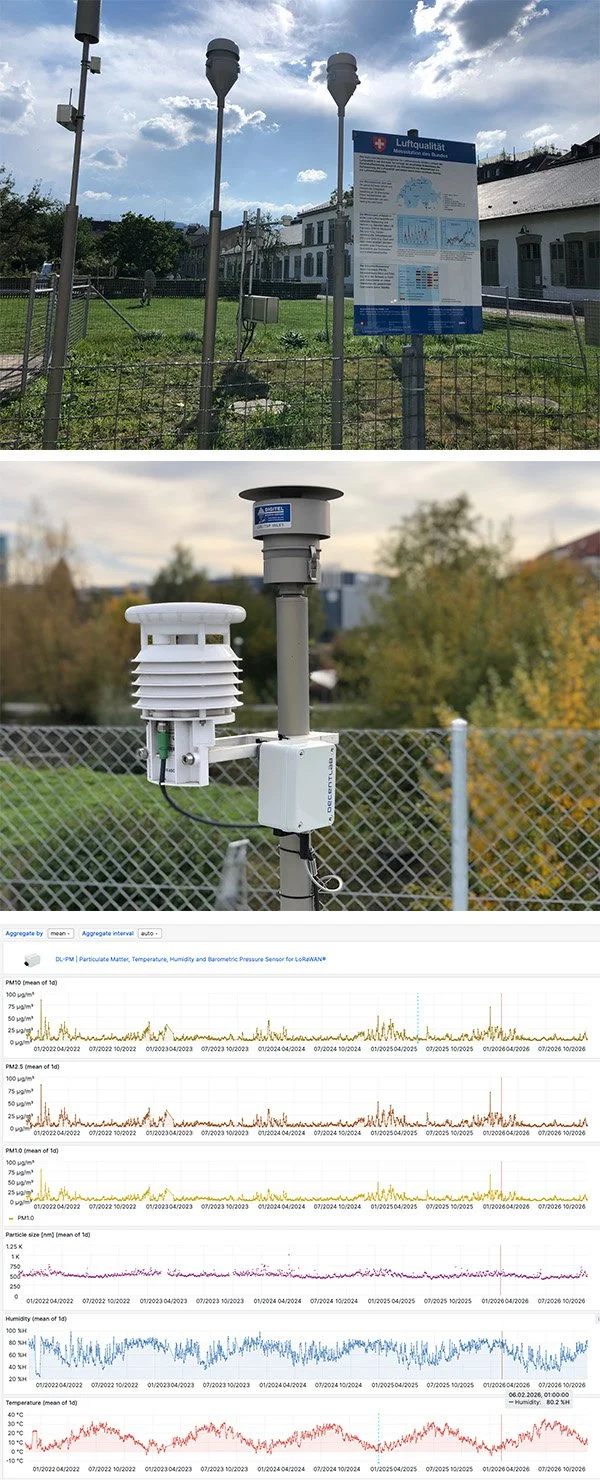
Long-term data matter too: our own DL-PM sensor in Dübendorf has been recording particulate matter since 2020, with the highest values each winter.
→ See it live: DL-PM real-time demo
→ Explore: Decentlab's air quality monitoring solutions