When the road sweats: a heat test at the SMARTinfeld Living Lab
/Three days, one measurement mast, a surprising pattern: as the air got warmer, the road surface cooled down. The test was documented by our customer and partner iot-shop (Alpha-Omega Technology), which runs the SMARTinfeld Living Lab in Germany.
Two of the data streams come from Decentlab sensors: the DL-ITST-002 | Infrared Thermometer / Surface Temperature Sensor for LoRaWAN®measures the road surface temperature contactlessly, the DL-ATM41 | Eleven Parameter Weather Station for LoRaWAN® provides measurements of air temperature, humidity, wind speed, solar radiation and much more. Traffic counting is handled by two third-party systems.
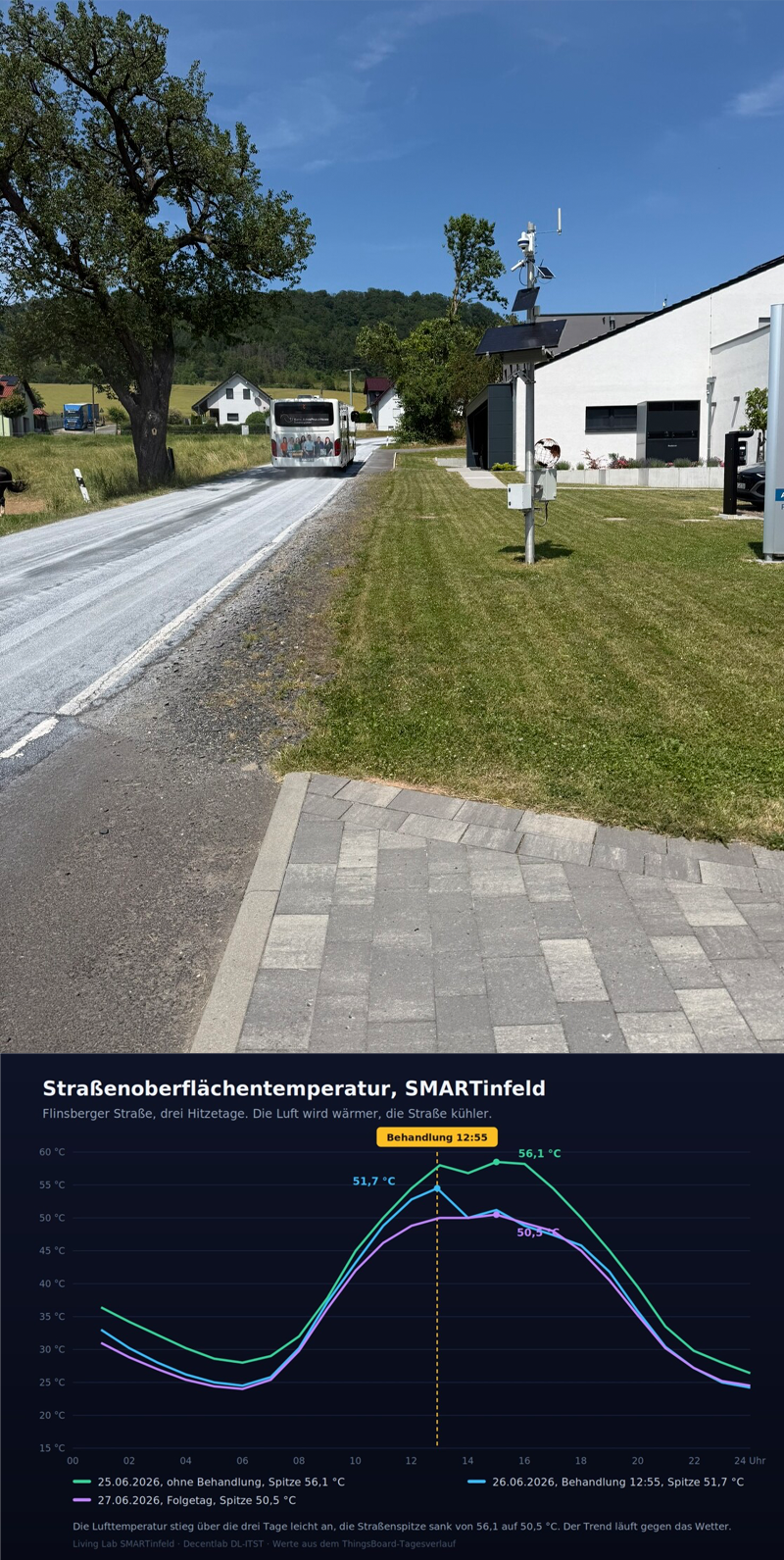
In heat, asphalt softens, the bitumen rises to the surface and the road "bleeds" – it turns shiny, sticky and loses grip. Whether a bright-coloured surface treatment helpsbecame clear in the test. The temperature curve from the DL-ITST-002 shows it: on 25 June, with no intervention, the road climbed to 56.1 °C. On 26 June, after a bright-coloured layer was applied, the peak dropped to 51.7 °C – despite warmer air. On 27 June, the hottest day, it stayed at 50.5 °C, and the effect lasted into the next day.
That it wasn't the weather is confirmed by the DL-ATM41: the untreated 25 June had the most variable radiation yet the highest road temperature – if clouds were the cause, it would be the other way round. And the two traffic systems pinned down the moment of treatment. Only all sources together give the full picture.
The interesting part is the comparison with a method tested at the same time: cooling asphalt with water daily. Water works instantly, but only while it evaporates – a light surface keeps working passively. And in a summer when water is scarce and agriculture is struggling, iot-shop raises the fair question of how sensible it is to evaporate water onto roads. Such trade-offs are better made with data than gut feeling.
Decentlab products in the IoT-Shop
Read the full story by iot-shop