Sensing Rome's microclimate
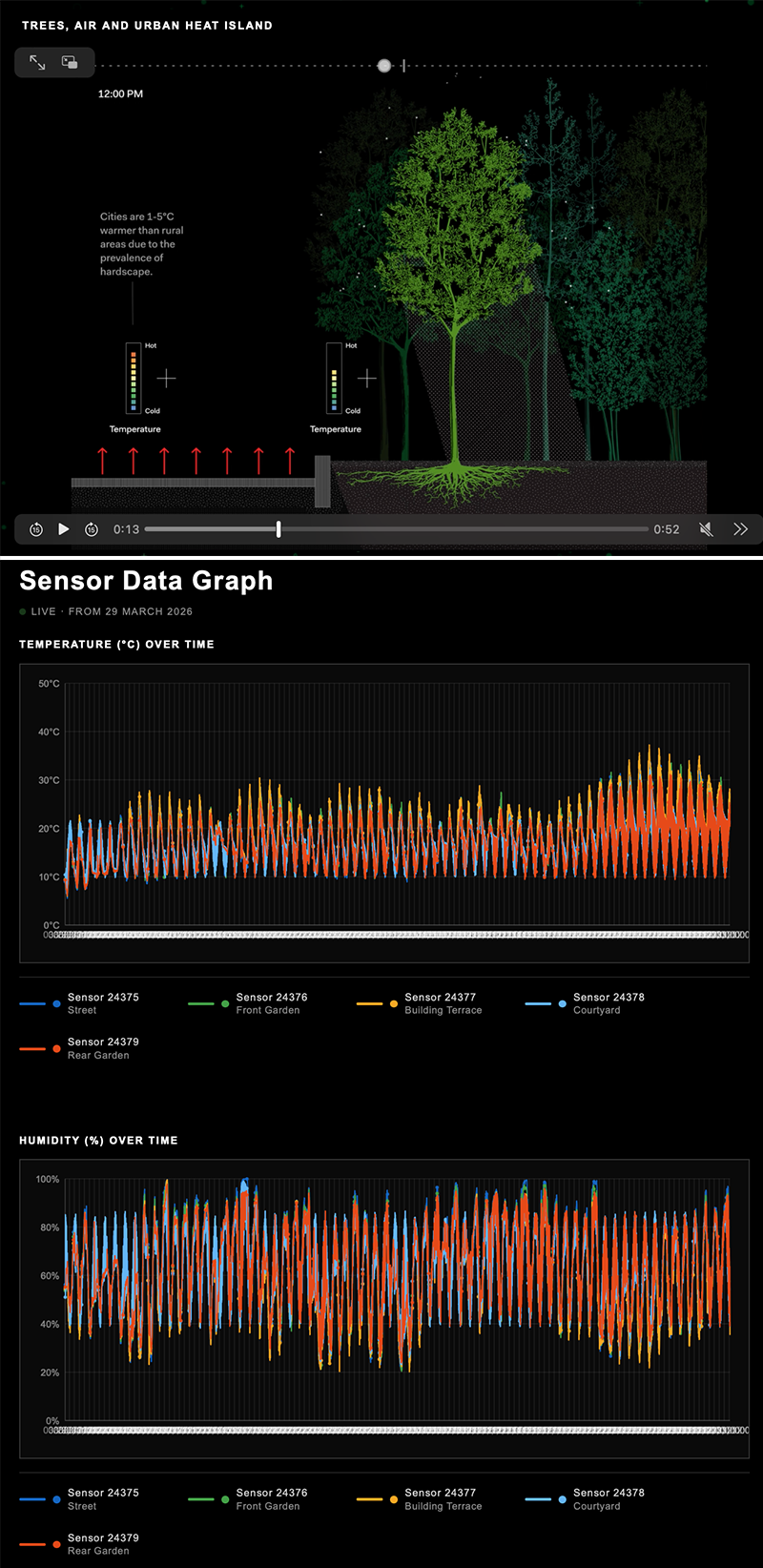
/Atmospheric Commons is a project by researchers from Harvard GSD (Craig Douglas & Max Piana), and ETH Zurich (Justin Booz). Across the grounds of the American Academy in Rome, a network of 47 sensors continuously measures air temperature and humidity, the relative heat index, soil moisture, and the sap flow of one of the courtyard cypress trees. Decentlab contributed seven DL-SHT35-001 | Air Temperature and Humidity Sensor with Radiation Shield for LoRaWAN® to the network.
The project builds on earlier work, including the Cool Forest installation at the 2025 Venice Architecture Biennale — a planted pavilion in the Arsenale where sensors measured the cooling effect of trees adapted to Venice's future climate. From Venice to Rome, the same question: how do trees shape the air around them, and how can we design cities that work with that?
The premise: trees are not passive background, they are active climatic infrastructure. Through transpiration, shading, and pollutant absorption, they generate microclimatic cooling fields that mitigate the urban heat island effect. The sensor network in Rome makes those processes visible — turning the Academy's gardens into a living laboratory for climate-responsive urban design.
More about the project and live data: atmosphericcommons.com