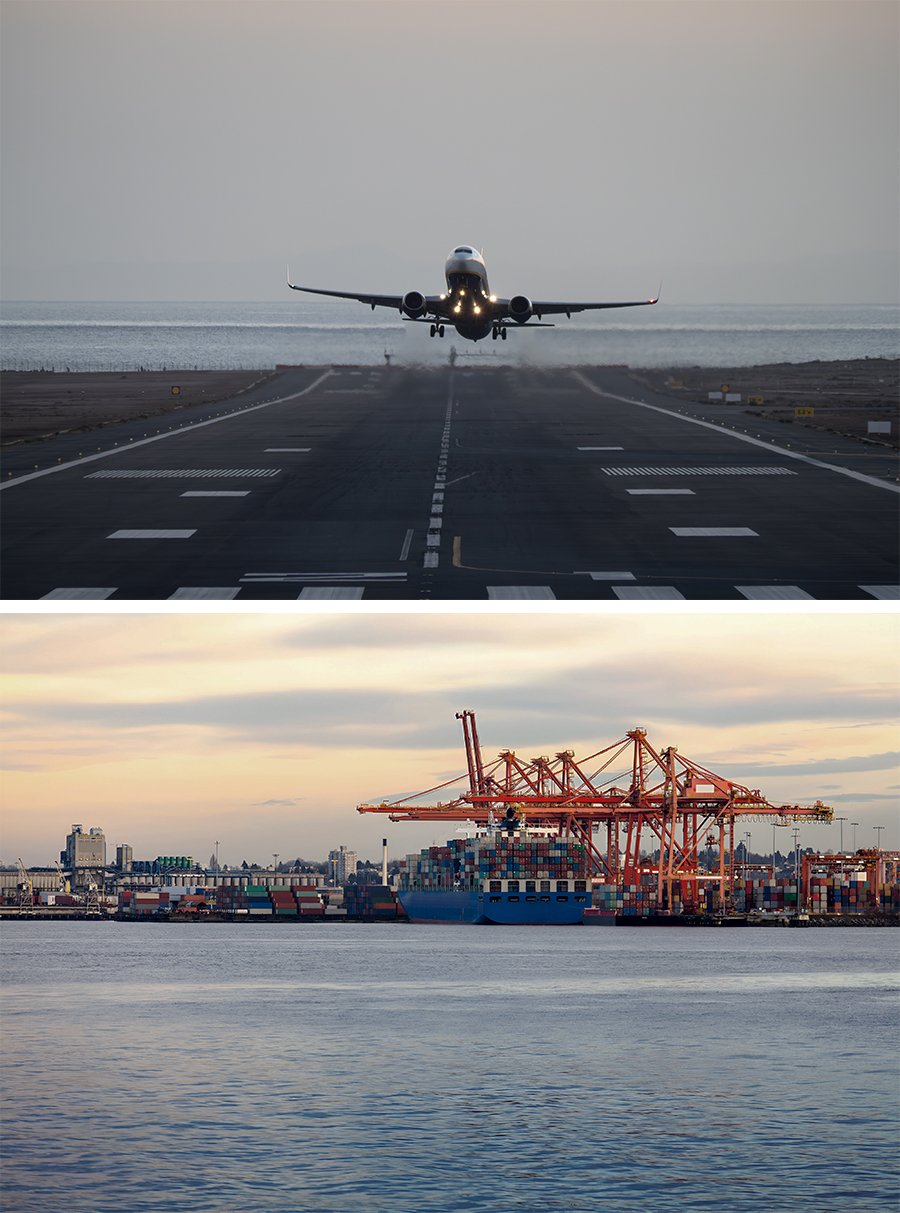
Rising air pollution from ports and airports calls for better monitoring
/Air pollution from ports and airports is increasingly coming into focus across Europe, as existing monitoring systems often fail to fully capture local pollution levels. A recent briefing by the European Environment Agency (EEA) highlights rising emissions from shipping and aviation and notes that air quality monitoring around these transport hubs is frequently insufficient.
According to the EEA, pollutants such as nitrogen dioxide (NO₂) and fine particulate matter (PM₂.₅) are of particular concern for people living near ports and airports. While official monitoring stations provide valuable long-term data, their location and spatial coverage often limit their ability to detect pollution hotspots close to emission sources, leading to potential underestimation of local exposure levels.
The briefing emphasises that ports and airports are complex emission environments, where multiple sources—such as ships, aircraft, ground traffic and related activities—interact within a small area. Capturing these dynamics requires monitoring approaches that better reflect spatial variability and short-term concentration peaks.
To address these gaps, the EEA calls for denser and more strategically placed air quality monitoring networks around ports and airports. More locally representative measurements are essential for accurately assessing population exposure and supporting the implementation of upcoming EU air quality standards.
Read fulll article
Devices for air quality monitoring:
DL-PM, DL-ATM22, Realtime Demo of DL-PM