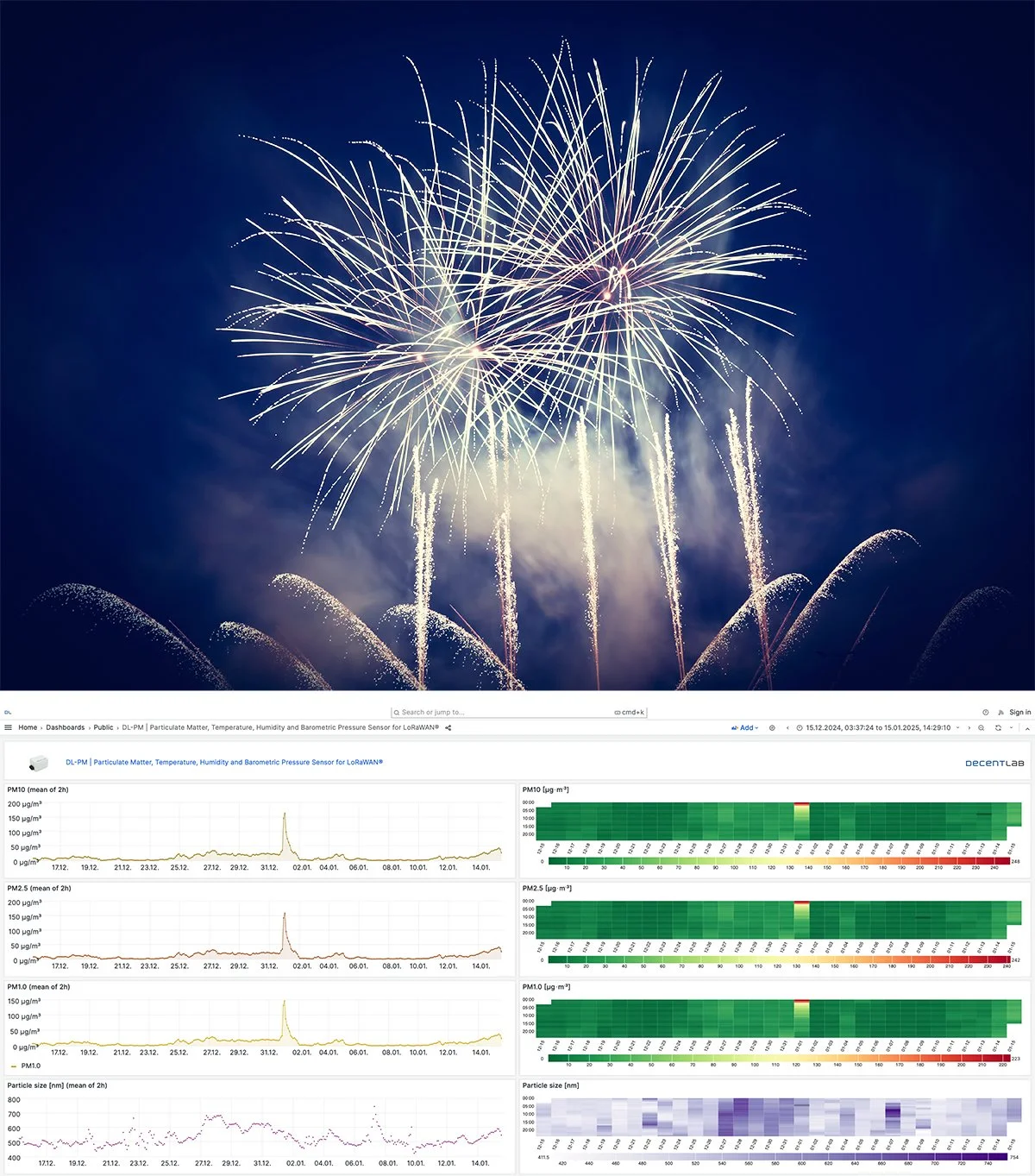
Environmental Impacts of the Festive Season
/For many people, fireworks are simply part of New Year’s Eve and the start of the new year — but the beautiful lights also have a darker side. Every year alone in Switzerland, rockets and firecrackers produce around 200 to 400 tonnes of fine particulate matter, according to the Swiss Federal Office for the Environment (BAFU).
The most polluting fireworks are those with high emission levels: when they explode, they release not only black powder but also color-producing metal compounds — and with them, a significant amount of airborne particulate matter.
Especially under unfavorable weather conditions — for example, cold temperatures or an inversion layer on New Year’s Eve — these particles can remain trapped in the air for a long time. Measurements show that during such conditions, fireworks alone can cause legal limit values for particulate pollution (PM₁₀) to be significantly exceeded.
Read full article
Would you like to watch in real time how PM levels change during New Year’s Eve?
Visit our public dashboard with live data.
Device for measuring particulate matter: DL-PM